


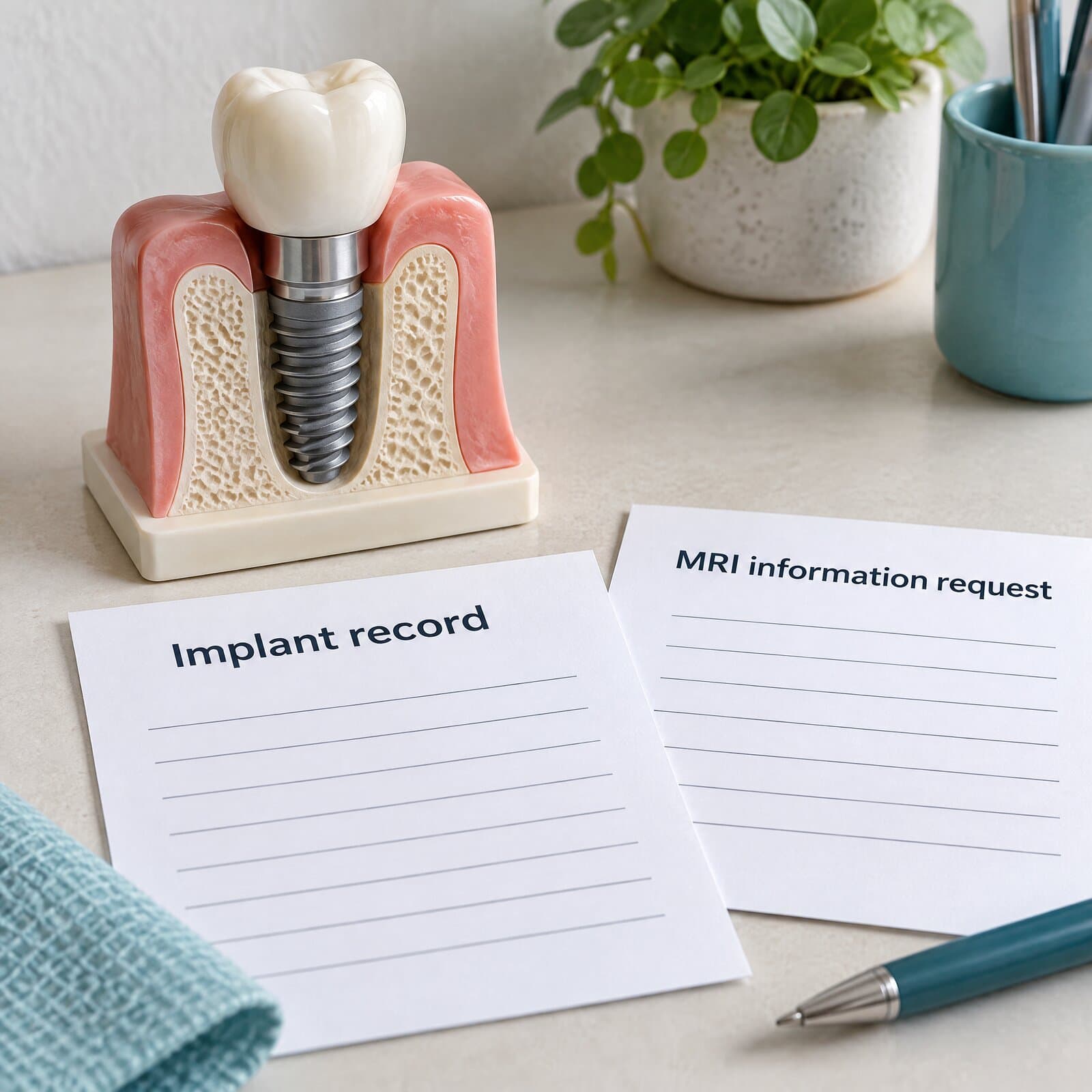
Your MRI form asks about implants, but you don’t have the paperwork for the tooth you had replaced years ago. You may remember the dentist and roughly when it happened, without knowing the name of the implant.
Tell the MRI service about the implant before the scan and take any implant documents you have. InsideRadiology’s MRI guidance explains that these documents help staff identify the device and assess whether you can have the examination. Ask the service what information it needs before requesting records.
For someone in Bassendean, that means keeping two conversations separate: asking the dental practice for information about existing treatment, and asking the MRI service to assess the scan. A new implant consultation answers a different question.
Why does an MRI form ask about dental implants?
MRI uses strong magnets and radiofrequency pulses to produce images of the inside of your body. InsideRadiology explains that the magnetic fields can interact with metal, electronic and magnetic objects in or on the body. That is why the safety questionnaire asks about implants, even when the appointment is for a different part of your body.
The same guidance names magnetic dental implants among devices needing particular attention and says these devices must be accurately identified before the scan proceeds. It also explains that some devices may be suitable for MRI once identified. Reporting an implant is therefore a request for assessment, not a conclusion that you cannot have the scan.
HealthyWA’s MRI information also tells patients to disclose metal implants and false teeth. It warns that these objects may add to the risks and may cause a scan to be cancelled. Give staff the details you know, rather than deciding that dental work is too small or too far from the area being scanned to mention.
If the form uses a term you don’t recognise, ask the MRI service what it means. You can say that you have a replacement tooth but need help confirming the type of dental work. Leave an uncertain detail as a question for the team rather than filling the gap with a guess.
What implant records should I ask the dental practice for?
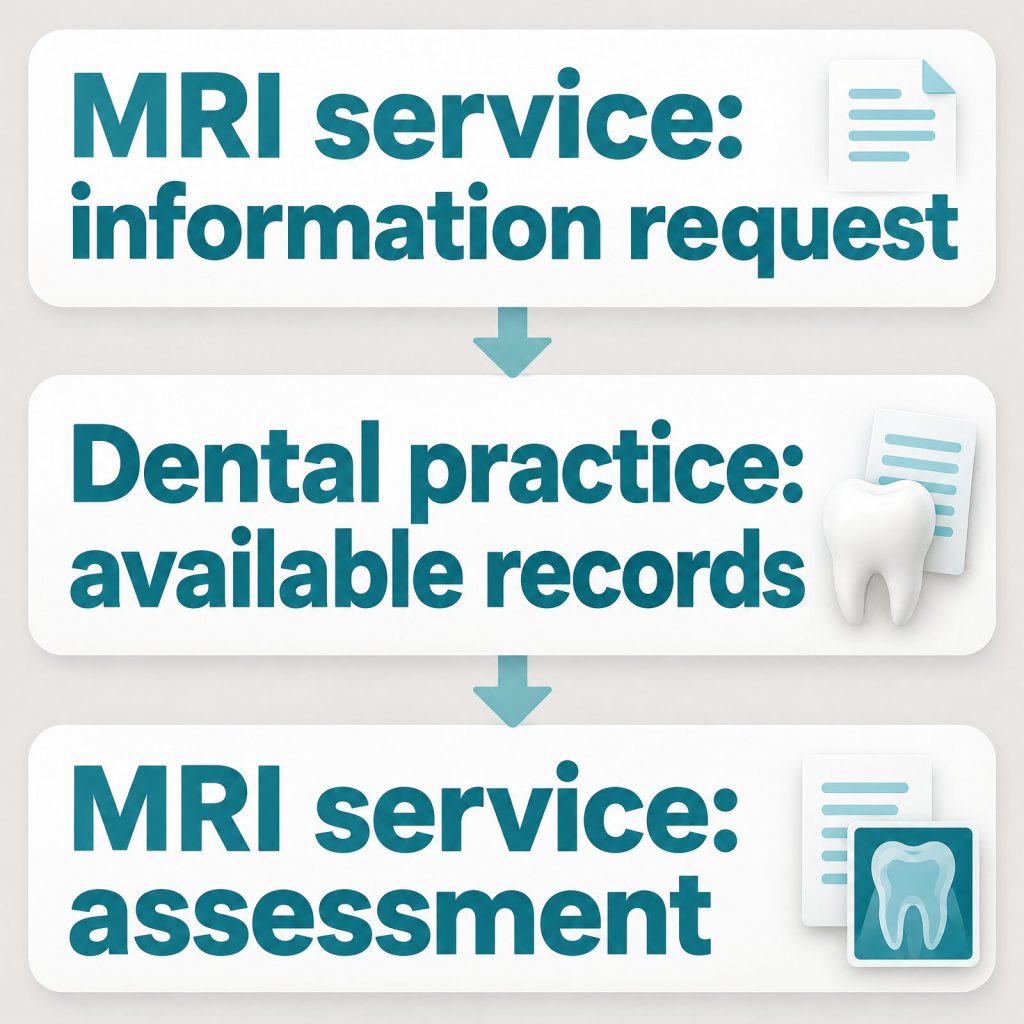
Start with the MRI service’s request, then ask the practice that carried out the treatment which documents it holds. InsideRadiology recommends taking implant documents to the appointment because they can help identify the implant type. It does not give every patient the same dental-records shopping list.
You might have been given an implant card, a treatment letter or other paperwork. Ask whether the practice can locate relevant information in your record, and pass on any specific request from the MRI team. Ask about a manufacturer or model only if the service has requested it; you don’t need to invent technical details yourself.
A records-request checklist
- Give the practice your name and the approximate treatment date. Ask how it would like you to confirm your identity.
- Explain that you are looking for information about an existing implant for an MRI, rather than booking to discuss a new implant.
- Send the MRI service’s exact request, including any document or device details it has named.
- Ask what relevant documents the practice holds and whether any part of the request needs the treating dentist’s attention.
- Confirm how the information should reach the MRI service and whether you should keep a copy to take with you.
- Tell the practice your scan date and ask when it expects to respond. If the timing is uncertain, update the MRI service.
If Absolute Smiles did not carry out the treatment, explain where it was done when you make contact. Ask the original provider about its records rather than assuming another practice already has them.
Does it matter whether I have a single implant or a denture?
Describe the dental work you actually have and let the MRI team ask for any further detail. Absolute Smiles has separate information about single implants and implant-supported dentures. Its denture page describes dentures held in position by implants. These are useful descriptions to recognise when explaining previous treatment.
Neither service name establishes MRI suitability. InsideRadiology’s screening advice is about identifying the particular device, and its reference to magnetic dental implants should not be turned into a statement that every dental implant is magnetic. Equally, a general description of an implant material does not identify all the dental work in your own record.
If you don’t know how your denture attaches, say so. You could ask the dental practice: “The MRI service wants details of my dental work. Can you confirm what is recorded and whether there are any attachments I should tell them about?” Pass the response to the MRI team rather than choosing an answer from a general article.
HealthyWA’s advice to disclose false teeth is another reason to mention a denture as well as any implants. Ask the MRI service what it wants you to do with dental appliances before entering the scan room. Follow its instructions for your own appointment.
What if I can’t get the records before the scan?
Contact the MRI service before the appointment and explain exactly what is missing. InsideRadiology says radiographers may ask you or your doctor for more information about an implant and will assess whether you can enter the scanner. Its preparation advice also says an alternative test might need to be arranged.
Tell the service which practice you have contacted, what information you already have and when you expect a response. If the original dentist has moved or the clinic has closed, explain that too. Ask what the service needs next and what that means for the existing booking. Don’t assume that silence from the dental practice means the scan has been cleared.
What to say if the appointment is close
“My MRI is booked for [date]. I have dental work that may include an implant, and I’m still trying to get the records. This is the information I have so far. Can your MRI team tell me what else you need and whether anything needs to change about the appointment?”
Keep a note of who you spoke to and the instructions you were given. If the dental practice later sends more information, ask the MRI service how to add it to your booking. The aim is to get the available information to the people assessing the scan, rather than making that assessment yourself.
Do I need a dental appointment just to request records?
Ask the practice whether your enquiry can be handled as a records request or needs an appointment. There is a difference between locating information about treatment you have already had and assessing a dental concern. Explain which of those you are asking about before choosing an appointment type.
Absolute Smiles’ implant consultation information describes an assessment for people considering implant treatment. It sets out a medical and dental history discussion, an oral examination and diagnostic records, treatment recommendations, and planning. That published pathway does not mean everyone requesting old records needs a new implant consultation.
If you also want to discuss implant treatment
The consultation page says the dentist asks about your medical and dental history and expectations, then considers findings and discusses the available options. If that is also the conversation you want, tell reception when enquiring. Ask what the appointment will cover, which records you should bring and what it will cost.
For broader questions about finding a local practice and what to ask before a visit, our guide to choosing a dentist in Bassendean covers that separate topic. For an MRI records enquiry, keep the request focused on the information the imaging service has asked for.
Who pays for the records request, dental visit and MRI?
Ask each provider about its own charges before agreeing to a service. When contacting the dental practice, ask whether there is a charge for the records enquiry and whether a separate appointment is proposed. Don’t assume the fee for one includes the other.
Services Australia’s guidance on tests and scans says diagnostic imaging providers set their own fees and advises asking what you will pay before the test. If a provider bulk bills, you will not have to pay for that service. Ask the MRI provider about your particular booking rather than assuming all MRI scans have the same fee or cover.
Its Medicare guidance also says Medicare does not cover most dental services. Help with an imaging cost is not confirmation that a private dental appointment will be covered. Ask for an estimate for any proposed dental appointment separately.
Questions to ask before your MRI appointment
Once you have made the records enquiry, use the MRI service’s response to check what remains outstanding. These questions keep the paperwork and appointment arrangements together.
Ask the MRI service
- What information do you need about my dental implant or denture?
- Have you received the documents I sent, and is anything still missing?
- Should I bring copies to the appointment?
- Who should I contact if the dental practice sends more information?
- Are there any instructions about dental appliances for my visit?
Ask the dental practice
- Do you hold records of the treatment I have described?
- Can you respond to this request from the MRI service, or is more information needed?
- Does my request need an appointment, and are there any fees?
- When should I follow up if I haven’t heard back?
Frequently asked questions
Can I have an MRI if I have a dental implant?
The MRI service needs the details of your implant to assess that. InsideRadiology says some implants may be suitable once accurately identified; a general article cannot establish the answer for your device. Tell the service before the scan and follow its screening instructions.
Is an old X-ray enough to identify the implant?
Ask the MRI service whether the information you have answers its request. InsideRadiology recommends bringing implant documents and previous imaging, but does not say an old dental X-ray replaces identification of the device.
Should I cancel if I can’t find my implant card?
Tell the MRI service what is missing and ask about the booking. InsideRadiology says more information or an alternative test may be needed. A missing card is a reason to contact the team, not to make the scan decision yourself.
To make a records enquiry, contact Absolute Smiles at 1 Old Perth Road, Bassendean WA 6054, or call (08) 9279 7956. Published hours include Tuesday, 8 am to 7 pm, and Saturday, 8 am to 1 pm. Ask when the team can respond to your request.
You can say: “I have an MRI booked and I’m trying to locate information about existing implant treatment. The MRI service has asked for these details. Can you tell me what records you hold and whether I need an appointment?”
By Sandeep Sharma, Principal Dentist, Absolute Smiles.
Sources checked 20 October 2026. This article explains general published guidance, not advice about your own dental treatment or MRI suitability. Sources are linked where used: InsideRadiology’s MRI guidance (last modified 31 October 2018), HealthyWA’s MRI information, Services Australia’s Medicare guidance, and Absolute Smiles’ service and contact information.
Photos in this article are AI-generated illustrations, not photos of Absolute Smiles, its staff or patients.


