



If you’re sorting this out near Absolute Smiles in Bassendean, this guide walks through what usually happens and what only a check-up can decide.
You want to know what Bupa may pay before you sit in the dental chair. That’s reasonable, but the answer depends on your policy, its current limits and the treatment you need. At Absolute Smiles in Bassendean, the useful starting point is to separate what the dental practice can estimate from what Bupa must confirm about your cover.
Contents
- 1 How does Bupa dental cover work at a dentist?
- 2 What should you check with Bupa before your appointment?
- 3 What information should you bring to the dental practice?
- 4 How do dental item numbers and benefit estimates help?
- 5 How is your likely gap payment worked out?
- 6 Does Bupa cover every type of dental care?
- 7 Should dental pain wait until your cover is confirmed?
- 8 Frequently Asked Questions about Bupa dental cover
How does Bupa dental cover work at a dentist?
Bupa dental benefits depend on your membership, extras policy, waiting periods, annual limits, treatment item numbers and any provider arrangement applying on the treatment date. Having Bupa cover doesn’t mean every service will receive a benefit or that two members will pay the same amount. The practice can explain its fees and proposed item numbers, while only Bupa can confirm your current policy benefits.
Think of the claim as a hand-off between three parties:
- You provide the correct membership details and ask Bupa about your policy.
- The dental practice examines you, explains the recommended care and supplies the relevant fees and item numbers.
- Bupa assesses whether a benefit applies under the policy held by the member receiving treatment.
That distinction matters. A staff member may help you prepare a useful estimate, but they can’t see every policy condition or decide how Bupa will assess a claim. Your cover may also differ from another family member’s cover, even when both names appear on the same membership.
For broader Australian information about dental visits, prevention and oral health, see Healthdirect dental care guidance.
What should you check with Bupa before your appointment?
Before your visit, ask Bupa to confirm that your membership and extras cover are active, whether waiting periods apply, how much of the relevant annual limit remains and whether the expected care has exclusions or provider conditions. You should also ask if Bupa needs item numbers, a written estimate or pre-approval before it can give you more specific information.
Bupa dental questions: who can answer each one?
| Your question | Dental practice can explain | Bupa can confirm |
|---|---|---|
| What treatment is recommended? | Findings from your examination and the clinical options discussed with you | Not a clinical decision |
| What will the practice charge? | Quoted fees for the proposed services | How the policy benefit may apply to those fees |
| Which item numbers are involved? | Item numbers for the care currently proposed | Whether those items are eligible under your policy |
| How much cover remains? | Not usually visible in full | Waiting periods, exclusions and remaining limits |
| Will pre-approval be needed? | Can provide supporting details if requested | Whether your policy or proposed care requires it |
| What will my estimated gap be? | Fee minus the benefit information available at that time | The current benefit assessment under your policy |
Ask how the benefit is calculated. Depending on the product and service, Bupa may describe a fixed benefit amount, a percentage or another policy rule. Don’t assume the method used for one claim will apply to every item.
Write down the date, the reference number and the wording of the information Bupa gives you. If something later differs, that record makes it easier to identify what information was available when you asked.
What information should you bring to the dental practice?
Bring your current Bupa membership details and any correspondence, approval notices or benefit estimates related to the visit. Check that the member number and the patient’s dependent details are correct. Missing or mismatched information can delay a useful estimate, but staff can tell you what is still needed and which questions should go back to Bupa.
If you’re arranging care for a child or another person on the policy, confirm which dependent is attending. Similar names, an outdated card or an old screenshot can lead to the wrong details being used when an estimate is requested.
Useful information may include:
- your current membership card or digital membership details;
- the full name and date of birth of the person receiving care;
- any written benefit information already supplied by Bupa;
- an approval or reference number, if Bupa has issued one; and
- details of any relevant claims made earlier in the benefit year.
You don’t need to interpret the policy at the reception desk. Share what you have, then ask which part the practice can clarify and which part only Bupa can answer. You can also review the practice’s Bupa payment information at Absolute Smiles before attending.
If you want to check who may provide your care, the practice website publishes clinician profiles with AHPRA numbers.
How do dental item numbers and benefit estimates help?
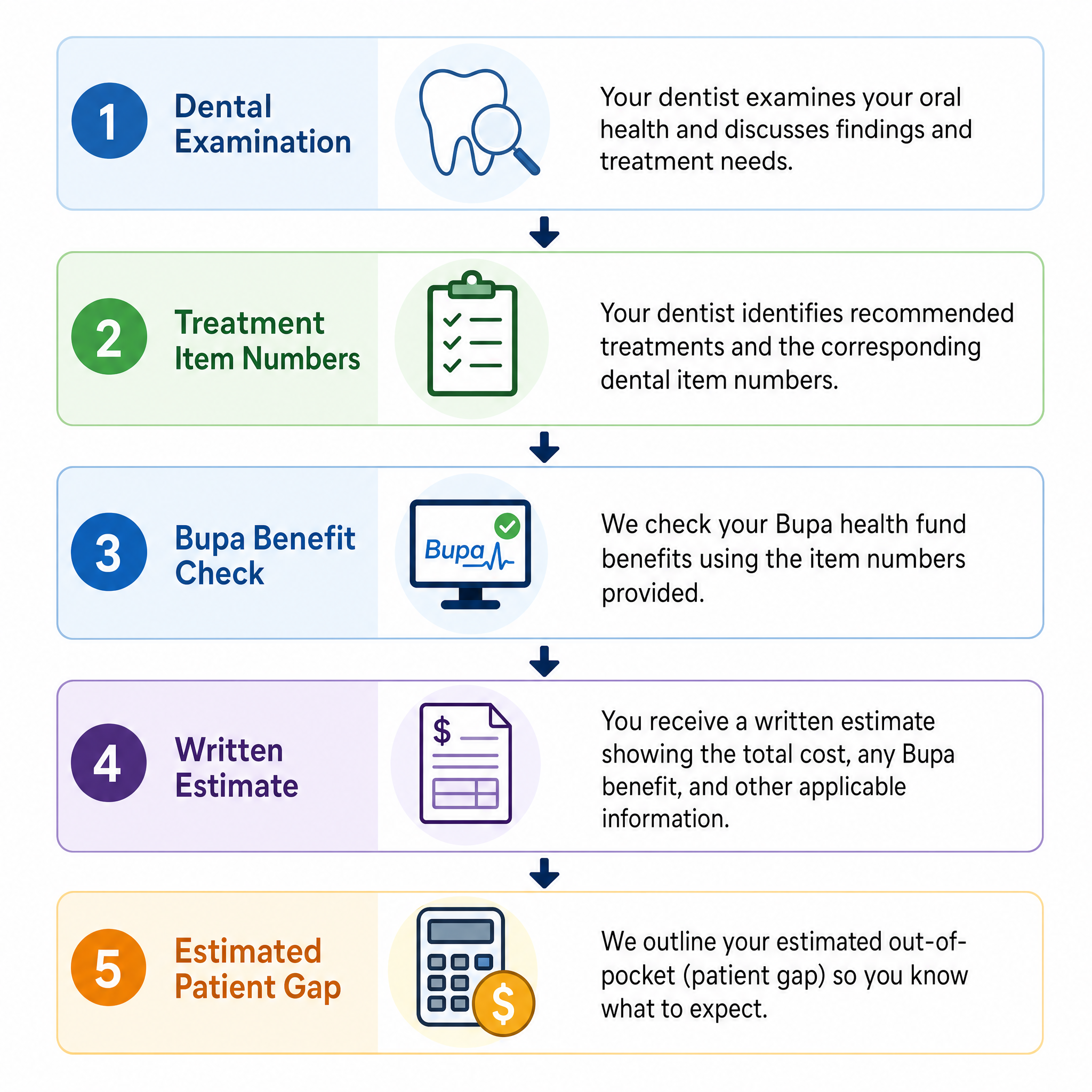
Dental item numbers identify particular services and make a benefit enquiry more specific. Once a dentist has examined you and discussed proposed care, the practice may provide relevant item numbers and fees for an estimate. Bupa can then assess those details against your policy. The estimate is financial information only; it doesn’t replace an examination, diagnosis or individual treatment recommendation.
A typical sequence looks like this:
- A dentist asks about your concern and examines your teeth, gums and mouth.
- You discuss the findings, available options and what may happen if care is delayed.
- The proposed services are matched to relevant dental item numbers.
- The practice prepares a written fee estimate for the care discussed.
- You or the practice use those details to request benefit information from Bupa.
- The quoted fee and available benefit information are used to estimate your gap.
The exact steps can vary with the type of care and the information Bupa requests. Sometimes an item number can’t be chosen reliably until the dentist has examined the area. A phone description such as “a broken tooth” may represent several different clinical problems, each requiring different care.
A benefit estimate also isn’t a final claim decision. It reflects the proposed items and policy information available at that point. The Australian Dental Association offers further Australian Dental Association resources for people seeking Australian oral-health information.
How is your likely gap payment worked out?
Your estimated gap is the quoted treatment fee minus the benefit Bupa is expected to pay for eligible services. Exclusions, annual limits, waiting periods and other policy conditions may affect that benefit. Because the calculation relies on both a clinical plan and current fund information, the amount remains an estimate until the treatment and claim have been assessed.
Quoted fee, confirmed benefit and estimated gap
| Part of the estimate | What it means | Who provides it? |
|---|---|---|
| Quoted fee (F) | The practice fee for the proposed item or group of items | Dental practice |
| Confirmed benefit information (B) | The amount Bupa indicates may be payable under the member’s current policy | Bupa |
| Estimated gap (G) | The amount left after subtracting the benefit from the quoted fee | Calculated from F − B |
The educational calculation is:
Quoted fee (F) − confirmed benefit (B) = estimated gap (G)
For several services, check whether Bupa has assessed each item separately. One item may receive a benefit while another may be excluded or affected by a remaining annual limit.
The amount can also change when the clinical picture changes. An examination or later stage of care may identify a different need from the one originally discussed. Bupa may also apply policy information that wasn’t available when the estimate was prepared. If an estimate changes, ask which fee, item number or policy condition changed. That gives you a concrete answer rather than a vague total.
Does Bupa cover every type of dental care?
You can’t assume that a treatment category is covered just because your policy includes dental extras. Eligibility depends on the exact policy, the person receiving care, the relevant item numbers, waiting periods, exclusions and remaining limits. Ask Bupa about the proposed items rather than relying on a broad label such as preventive, children’s or restorative care.
For example, you might ask about:
- an examination or preventive service;
- dental care proposed for a child or dependent;
- treatment intended to restore a damaged tooth; or
- a custom-made mouthguard.
These are useful categories for discussing the clinical purpose of care, but they don’t establish whether Bupa will pay a benefit. The pages on children's dental care in Bassendean, restorative dental care and custom mouthguards provide clinical context. Policy questions still need to be checked with Bupa using your own membership details.
Only an examination can establish what care is appropriate for you. Cover shouldn’t decide the diagnosis, and a higher benefit doesn’t make one clinical option suitable for every person.
Should dental pain wait until your cover is confirmed?
Significant dental pain or signs of a potentially urgent problem shouldn’t be delayed solely while you confirm insurance. Seek prompt professional assessment for facial swelling, dental trauma, uncontrolled bleeding, fever with dental symptoms, difficulty swallowing or difficulty breathing. If breathing or swallowing is affected, contact emergency services or attend an emergency department.
Insurance and clinical urgency answer different questions. Bupa can explain how your policy may respond to a claim; a dentist or other appropriate health professional must assess what is causing your symptoms and what care is suitable.
When you call a dental practice, describe what is happening plainly:
- where the problem is and when it began;
- whether swelling is present or increasing;
- whether a tooth was knocked, cracked or displaced;
- whether bleeding has continued despite pressure;
- whether you have fever or feel generally unwell; and
- whether swallowing or breathing has changed.
Those details help the practice advise how soon you should be assessed. They can’t establish the cause over the phone. Even if your benefit information isn’t ready, ask about the next clinical step and discuss fees separately.
Frequently Asked Questions about Bupa dental cover
The short answer is that the practice can explain your proposed care, fees and item numbers, while Bupa controls information about your policy benefits. Your likely gap depends on both sides of that calculation. Ask for written details where possible, and remember that a clinical change or a policy limit can alter an earlier estimate.
Can Absolute Smiles tell me exactly what Bupa will pay?
The practice can give you its fees, proposed item numbers and an estimated gap based on the benefit information available. Only Bupa can confirm how your current policy applies to the member and services involved. Ask Bupa for a reference number when it provides benefit information.
Will I have a gap payment?
Possibly. Your gap depends on the practice fee, the benefit payable for eligible items, remaining limits and other policy conditions. If Bupa pays no benefit for an item, the gap may equal the quoted fee for that item.
Do I need item numbers before contacting Bupa?
You can ask general policy questions without them. Item numbers become useful when you want an estimate tied to particular proposed services. A dentist may need to examine you before the appropriate numbers can be identified.
Can my benefit estimate change?
Yes. The estimate may change if your examination alters the proposed care, different item numbers are needed, a policy limit has been reached or Bupa applies information that wasn’t available during the earlier enquiry. Ask for an updated written estimate if the plan changes.
Clinical disclaimer: This article provides general information and doesn’t replace individual dental advice. Consult a dentist about your own symptoms, treatment needs and circumstances. For policy benefits, limits and claim decisions, contact Bupa directly.


